When the Table Becomes the Battleground: Syrian American Families and the Conversations That Test Everything
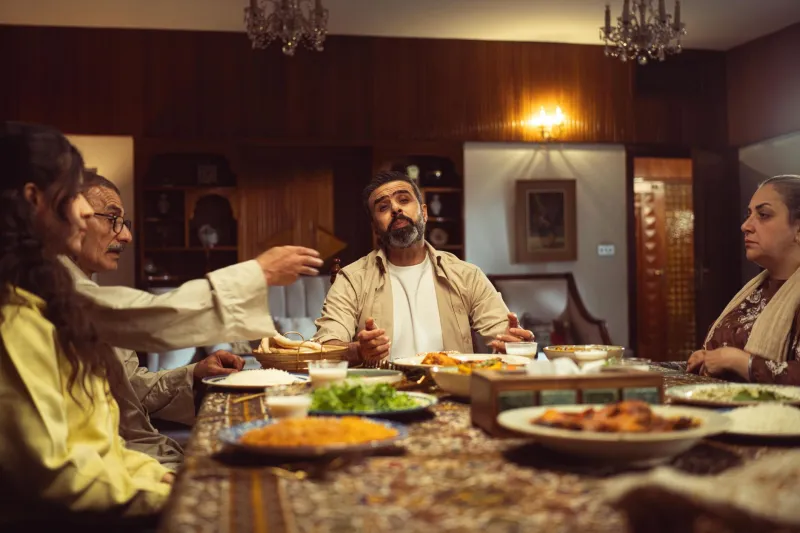
The lamb had been cooking since morning. The table in the Hamdan family's living room in suburban Virginia was set for eleven—cousins, an uncle visiting from Toronto, two grandchildren born in the United States who had never seen Syria. By the time the food was served, the conversation had already turned to Idlib.
It always turns to Idlib. Or to Aleppo. Or to the question that sits beneath every question in Syrian American households: What should have been done, and who is to blame for what was not?
For the Hamdans, as for countless Syrian American families scattered across this country, the dinner table has become something more complicated than a place to eat. It has become a forum, a courtroom, and occasionally a battlefield—where the accumulated grief and fury of more than a decade of crisis meets the generational and ideological distances that migration tends to create.
The Fault Lines
The divisions that emerge in these conversations do not follow a single clean axis. They are generational, certainly—but they are also shaped by when a family left Syria, under what circumstances, and what version of the country they carry in memory.
Those who departed before 2011 often hold a more complicated relationship with the Assad government than those who fled during the uprising. Some remember a Syria that, whatever its authoritarian character, functioned—schools, hospitals, a degree of social order. Others, particularly those who lost family members to the regime's prisons or barrel bombs, regard any ambivalence toward Assad as a form of moral failure.
Fatima Al-Hassan, a social worker in Dearborn, Michigan, describes the split in her own extended family with careful precision. "My aunt left Damascus in 1998. She lost her home, her neighborhood, her whole frame of reference for what Syria was. When she talks about the government, she's talking about something she lived with for forty years. My cousin who came here in 2015 is talking about something that destroyed everything she loved. They are not describing the same country."
This divergence is further complicated by the American political context. Syrian Americans who have become civically engaged find themselves navigating a domestic landscape in which Syria has become a proxy argument for debates about immigration, military intervention, and the limits of US responsibility abroad. Taking a position on Syria within the family often means, implicitly, taking a position on American politics—and that layering can transform an already charged conversation into something nearly unmanageable.
The Arguments That Keep Returning
Certain topics recur with particular intensity. The question of US military intervention—whether it should have happened sooner, whether it should happen at all—divides families along lines that do not always correspond to conventional political affiliations. Some of the most forceful advocates for intervention are deeply conservative; some of the most skeptical are progressive. The Syrian crisis has a way of scrambling familiar ideological categories.
Humanitarian aid presents its own complications. Families with relatives still inside Syria or in refugee camps in neighboring countries often have direct, immediate stakes in how international assistance is allocated and whether it reaches those who need it. When American news cycles ignore Syria—as they frequently do—the silence is felt as a form of abandonment. When coverage does return, it is often incomplete in ways that family members with firsthand knowledge find deeply frustrating.
And then there is the question of return. Who wants to go back, who believes it is possible, and under what conditions—this conversation, perhaps more than any other, reveals the emotional terrain beneath the political arguments. For older Syrian Americans, return is often a consuming dream. For those who came of age here, it can feel like an abstraction, or even a threat to the life they have built.
Youssef Hamdan, twenty-six, was born in Fairfax County, Virginia. His father came to the United States in 1994. At a recent family gathering, he found himself in an argument with his uncle about whether young Syrian Americans have an obligation to engage politically with the crisis. "He thinks I don't care enough," Youssef says. "But I care in a different way. I care about what I can actually do from here. That's not the same as not caring."
Learning to Stay at the Table
Despite the friction, most Syrian American families describe a powerful, shared reluctance to let these arguments become ruptures. The family unit carries a particular weight in Syrian culture—a weight that migration has, if anything, intensified. When you are far from home, the people who remember the same home become irreplaceable.
Dr. Sana Mourad, a family therapist in Los Angeles who works with Arab American communities, has observed this dynamic closely. "Syrian families often have a very high tolerance for conflict within the family, precisely because the family means so much," she says. "But that tolerance has limits. And the Syrian crisis has pushed many families to those limits."
Dr. Mourad emphasizes several communication practices she has found effective in helping families navigate these conversations without fracturing. The first is what she calls witnessing before arguing—creating space for each family member to describe their personal experience of the crisis before the conversation shifts to analysis or debate. "When someone has lost a brother, or a home, or a pregnancy because of what happened in Syria, that experience deserves to be heard before anyone starts talking about strategy or policy," she says.
A second approach involves deliberately separating grief from argument. Many of the most explosive family conversations conflate mourning—which is natural and necessary—with political disagreement, which is navigable. When the two are disentangled, the temperature in the room often drops.
Fatima Al-Hassan has developed her own informal version of this practice. "When it starts getting bad, I ask everyone to talk about a specific person they miss, or a specific place," she says. "Not about what should have been done. Just about what was. And something shifts. We remember that we're all grieving the same thing, even if we're angry about it in different ways."
What Survives the Argument
The Hamdan family's dinner did not end in silence. It ended, as it usually does, with tea and something sweet—a ritual that carries its own kind of meaning, a shared insistence that the meal continues regardless of what was said during it.
Youssef Hamdan admits that he and his uncle did not resolve their disagreement. They rarely do. But they stayed at the table. "That has to count for something," he says. "We come from a place that has been torn apart by people who couldn't stay at the table. We're not going to do that to each other."
In that refusal—to leave, to stop speaking, to let the argument become the last word—there is something that looks, from a certain angle, like hope.