Building America, Mourning Syria: The Engineers Who Pour Their Grief Into the Ground Beneath Their Feet
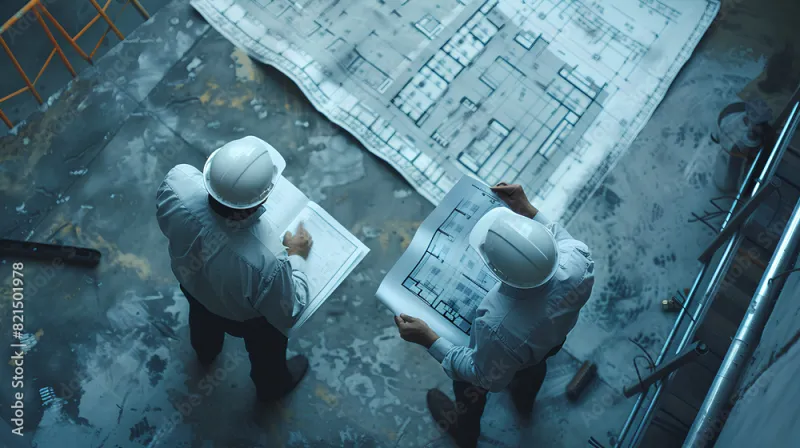
Photo: Syrian American engineer reviewing blueprints construction site urban planning, via as2.ftcdn.net
In a modest office on the outskirts of Detroit, a structural engineer named Mazen spreads a set of blueprints across a drafting table. The project is a pedestrian overpass in a neighborhood that has been waiting for safe street crossings for years. He traces the load-bearing supports with a pencil, pausing at each joint as though committing it to memory. "Every structure I design here," he says quietly, "I think about the ones that fell there."
Mazen is one of thousands of Syrian American professionals whose technical expertise has been absorbed into the fabric of American civic life. They design water treatment systems in Texas. They manage construction timelines in suburban New Jersey. They sit on city planning commissions in Minnesota, advocating for affordable housing in communities that look nothing like the ones they left behind—and everything like the ones they wish they could rebuild. Their contributions are largely invisible to the public they serve. And that invisibility, many say, mirrors something far more painful: the erasure of the country they came from.
The Architecture of Displacement
Syria, before the war, was a nation of considerable engineering ambition. Damascus maintained one of the oldest continuously inhabited urban cores in the world. Aleppo's medieval water infrastructure—a system of underground channels called qanats—survived for centuries before modern conflict reduced entire city blocks to rubble. The country trained engineers, architects, and urban planners at institutions like the University of Damascus and Tishreen University, producing graduates who went on to work across the Middle East and Europe.
When the civil war erupted in 2011, that professional class fractured along with everything else. Some stayed. Many fled. Those who arrived in the United States carried degrees, licenses, and decades of accumulated knowledge—alongside the particular anguish of watching, via phone screens and satellite images, the systematic dismantling of the built environment they had studied to understand and protect.
According to data from the Migration Policy Institute, Syrian immigrants in the United States are among the most highly educated refugee populations in the country, with a significant proportion holding advanced degrees in technical fields. Many have recertified their credentials under American licensing requirements, a process that can take years and cost thousands of dollars. Those who complete it often find themselves doing work that is, in technical terms, nearly identical to what they would have done in Syria—except that the ground beneath them belongs to someone else's country.
Civic Contribution as a Form of Witness
For Rania, a civil engineer based in the Chicago metropolitan area who specializes in stormwater management, the connection between her professional life and her homeland is not metaphorical. It is structural. "Syria had a flooding problem in certain regions," she explains. "I studied it. I wrote papers on it. And now I sit in meetings here and I solve the same kinds of problems for municipalities that have the funding and the political stability to actually implement solutions." She pauses. "It is a privilege I do not take lightly. And it is a wound I carry every day."
This dual consciousness—gratitude for the opportunity to contribute, grief over the context that made contribution elsewhere impossible—defines the professional identity of many Syrian Americans in technical fields. They are not merely immigrants who happen to work in infrastructure. They are displaced experts whose very competence is a reminder of what was lost.
Some have found ways to redirect that expertise toward Syria directly. Organizations like the Syria Recovery Trust Fund and various diaspora-led NGOs have recruited Syrian American engineers to consult on reconstruction planning, even as active conflict and political instability make large-scale rebuilding efforts nearly impossible. Others have joined academic initiatives documenting destroyed heritage sites, contributing technical assessments that may one day inform restoration efforts—if the political conditions ever permit them.
The Zoning Meeting Nobody Talks About
Back in the United States, the day-to-day work of Syrian American infrastructure professionals rarely makes headlines. It happens in city council chambers and planning board hearings, in utility trenches and on construction scaffolding, in the quiet accumulation of permits filed and inspections passed.
Khaled, an urban planner who settled in the Twin Cities after leaving Damascus in 2013, has spent the past several years working on transit-oriented development projects in communities with large immigrant populations. He describes attending public meetings where residents argue over bus routes and bike lanes, and feeling a dissonance he has never fully resolved. "People are frustrated about a road that takes ten minutes longer," he says, without judgment. "And I understand—that matters, it genuinely matters to their lives. But I also know what it looks like when roads are destroyed on purpose. When infrastructure is used as a weapon."
That knowledge, he argues, makes him a more thoughtful planner. He brings to his work an understanding of what infrastructure means beyond convenience—what it means as a guarantor of dignity, as a precondition for civic participation, as a target in conflict. "When I fight for a sidewalk in a low-income neighborhood," he says, "I am fighting for something I know the value of in a way that is hard to explain to someone who has never had it taken away."
What It Means to Build Without Being Able to Go Back
The irony that animates so many of these stories is not lost on those living them. Syrian American engineers are, in a very literal sense, strengthening the infrastructure of a country that is not Syria—while Syria's infrastructure continues to deteriorate under the combined weight of ongoing conflict, international sanctions, and a government that has, in documented instances, deliberately targeted civilian infrastructure as a military strategy.
United Nations reports have catalogued the destruction of hospitals, schools, water systems, and power grids across Syria with a specificity that reads, to a trained engineer, as a kind of technical horror. Mazen, the structural engineer in Detroit, keeps a folder on his computer of before-and-after satellite images of Syrian cities. He does not look at it often. "But I know it is there," he says. "It reminds me why the work I do here matters. And why it is never quite enough."
There is no clean resolution to this tension. These professionals are not building a bridge back to Syria. They are building bridges in America, for Americans, with skills that Syria gave them and that Syria can no longer use. They do it with competence, with civic commitment, and with a grief that has no outlet in blueprints or zoning codes.
If we were Syrian, we might understand that every structure built in exile is also, quietly, a memorial. That the work of making a place safer, more connected, more livable is not separate from the work of mourning what was made unlivable elsewhere. These invisible architects are doing both at once—and the least we can do is learn to see them.