Carrying Two Classrooms: Syrian Refugee Youth and the Hidden Weight Behind the Report Card
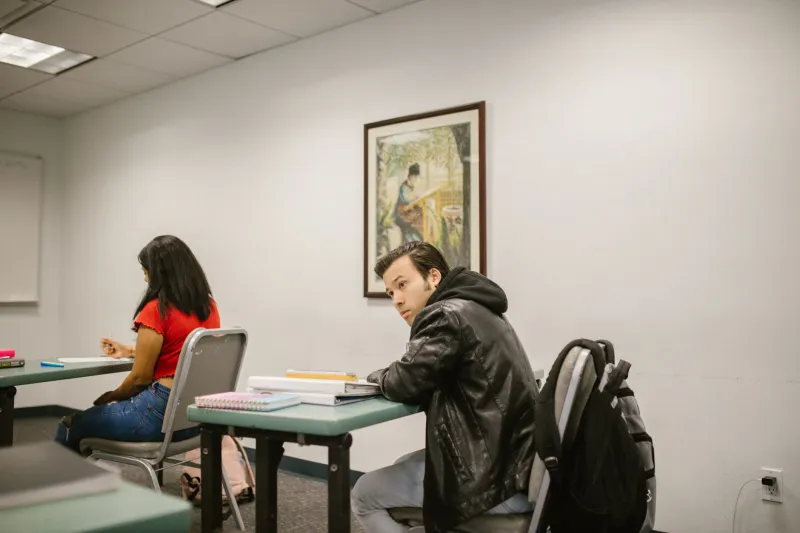
When Nour Khalil walked into her first American classroom in suburban Detroit, she did not know the English word for "present" when the teacher called roll. She raised her hand anyway, mimicking the students around her, and the teacher moved on. What no one in that room understood was that Nour had already been a student for years—not only in the formal sense, but in the harder school of war, displacement, and loss. She had studied how to sleep through shelling. She had learned which aid distribution lines moved fastest. She had memorized the faces of people who did not make it to Jordan with her family.
Nour, now seventeen and a junior at a high school outside Dearborn, Michigan, carries both educations with her every single day.
Her story is not singular. Across the United States, tens of thousands of Syrian refugee students are enrolled in public schools, from Minneapolis to Houston to suburban Virginia. They arrive at different ages, with wildly varying academic histories—some had strong schooling in Syria before the war interrupted everything; others spent years in refugee camps where formal education was inconsistent at best. What unites them is a shared and often invisible burden: they are expected to perform academically in a language they are still acquiring, in a culture they are still deciphering, while processing a trauma that most of their American classmates cannot begin to imagine.
The Gap Between Arrival and Belonging
American schools are legally required to provide English language learner support for students who qualify, but the quality and depth of those services vary enormously by district and state. In well-resourced suburban districts, newcomer programs can offer dedicated ESL instruction, bilingual counselors, and peer mentorship initiatives. In underfunded urban schools, a newly arrived Syrian student may receive a few hours of pull-out language support per week and be otherwise expected to sink or swim in a general education classroom.
Dr. Amira Saleh, an education researcher at Wayne State University who studies refugee integration in Midwestern schools, puts it plainly: "We design our support systems around the idea that the primary challenge is language. But language is often the least of it. These students are grieving. They are worried about parents still in Idlib. They are sending voice messages to cousins in Turkish camps at midnight and then trying to focus on algebra at eight in the morning."
The psychological dimension of this experience is chronically underestimated. Post-traumatic stress, complicated grief, and what clinicians call "ambiguous loss"—the particular anguish of mourning a homeland that still exists but is no longer accessible—manifest in ways that can look, from the outside, like behavioral problems or academic disengagement. A student who seems withdrawn or easily startled may be flagged for disciplinary reasons before anyone thinks to ask what he witnessed before arriving in this country.
What Educators Are Learning—and What They Still Need
In Clarkston, Georgia, a small city that has become one of the most ethnically diverse communities in the American South largely due to refugee resettlement, educators at Clarkston High School have spent years developing what they call a trauma-informed approach to working with students from conflict zones. Teachers receive professional development on recognizing the signs of trauma-related stress, and the school employs a dedicated refugee services coordinator who acts as a bridge between newly arrived families and the broader school community.
"The biggest shift for our staff was understanding that academic underperformance in these students is almost never about capability," says Marcus Webb, a guidance counselor at the school who has worked with Syrian and other refugee students for nearly a decade. "It is about capacity. A kid who watched his neighborhood get bombed does not have the same cognitive bandwidth available for a history test as a kid who grew up safely in a stable home. That is not a character flaw. That is neuroscience."
Still, even in schools with strong intentions, there are structural gaps. Interpreter services are inconsistent. Mental health resources are stretched thin. And perhaps most critically, the cultural competency of school staff—their ability to understand Syrian family dynamics, religious observance, and community expectations—remains uneven.
Peer Mentorship as a Bridge
One of the most promising interventions emerging in schools with significant Syrian populations is peer mentorship: pairing newly arrived students with older Syrian American or Arab American students who can serve as cultural and linguistic guides. These programs operate on the recognition that formal institutional support, however well-intentioned, cannot replace the comfort of speaking to someone who genuinely understands your specific experience.
At a high school in northern Virginia, a student-led program called "Marhaba"—Arabic for "welcome"—matches Syrian newcomers with upperclassmen who have themselves navigated the American school system as refugees or children of refugees. The program covers practical logistics: how to navigate the cafeteria, what to do if a teacher misunderstands you, how to request prayer accommodations without feeling singled out. But it also creates space for something less tangible: the simple relief of not having to explain yourself.
Yazan, a senior who co-founded the Marhaba program after his own difficult transition three years ago, describes the mission simply. "When I arrived, I felt like I was invisible unless I was a problem. Nobody asked me what I missed about Syria. Nobody asked me what my life was like before. I was just 'the refugee kid.' This program tries to make sure the next kid who comes through that door feels like a person first."
What American Schools Owe These Students
The question of what public schools owe Syrian refugee students is, at its core, a question about what kind of society the United States aspires to be. These are young people who did not choose displacement. They did not choose to grieve in a second language. They did not choose to become, at twelve or fourteen or sixteen, the translators and cultural interpreters for their entire families in a country that was not their first choice of destination.
What they do choose, every morning, is to show up. To try. To carry both classrooms—the one in their past and the one in front of them—and somehow keep moving forward.
If we were Syrian, we would hope that the schools our children entered would see that effort for what it is: not a baseline expectation, but a profound act of will. And we would hope that the institutions meant to educate them would meet that will with something more than a standardized test and a seat in the back of the room.
The research on what works is increasingly clear: trauma-informed pedagogy, robust mental health services, culturally competent staff, and peer mentorship programs all make measurable differences in outcomes for refugee students. What is less clear is whether American school systems—underfunded, overstretched, and politically contested as they are—will commit to implementing these approaches at scale.
Nour, for her part, is now applying to colleges. She wants to study public health. She still wakes up some nights, her mother says, from dreams about the city she left behind. But she also, increasingly, dreams about what comes next.
Both things can be true at once. That is something she learned in neither classroom—and in both of them.