The Silence That Hurts: Confronting the Mental Health Crisis Hidden Inside Syrian American Homes
Hamid Sarraf does not use the word depression. He never has. At 56, he has buried a nephew killed in the siege of Homs, rebuilt his life twice — once in Beirut, once in Nashville — and watched his children grow up in a country whose language took him years to learn. He describes himself, when pressed, as "tired." He says he sometimes cannot remember why he walked into a room. He says there are mornings when getting dressed feels like a negotiation with himself that he is not certain he will win.
What Hamid describes is recognizable to any clinician trained in trauma response. What Hamid would never do is call a therapist.
"That is for people who cannot handle their lives," he says quietly, with no hostility, only a kind of settled certainty. "I have handled much worse than this."
His experience is not exceptional. Across Syrian American communities — in the suburbs of Detroit and Houston, in the apartment buildings of Brooklyn and Anaheim — a parallel crisis unfolds in near-total silence. Researchers, social workers, and community health advocates describe a population carrying extraordinary psychological burdens while operating under cultural frameworks that make seeking help feel like an admission of failure.
What the Research Tells Us
The scale of trauma exposure within Syrian refugee and immigrant communities is, by any clinical measure, severe. Studies published in journals including The Lancet and the Journal of Traumatic Stress have documented rates of PTSD among Syrian refugees that range from 30 to 50 percent in some displaced populations — figures that dwarf the roughly 7 percent lifetime prevalence in the general US population.
Those who resettled in the United States carry those experiences with them. Displacement itself compounds the original trauma: the loss of home, community, professional identity, and social status creates what psychologists sometimes call "cumulative grief" — a layering of losses so dense that individuals may struggle to identify where one wound ends and another begins.
Dr. Nadia Haddad, a licensed clinical psychologist in Dearborn, Michigan, who specializes in refugee mental health, describes a pattern she encounters regularly in her practice. "People come to me with physical complaints first — headaches, insomnia, digestive problems. Sometimes they come because a doctor referred them and they feel they have no choice. Very rarely does someone call and say, 'I think I need help with my mental health.' That language doesn't map onto how many of my clients understand their own suffering."
The Architecture of Silence
Understanding why mental health goes unspoken within Syrian communities requires understanding several reinforcing forces that operate simultaneously.
The first is cultural. In many Arab communities, psychological distress is historically expressed through somatic language — the body speaks what the mind is not permitted to name. Fatigue, physical pain, and diffuse illness are socially acceptable descriptions of suffering in ways that "anxiety" or "trauma" are not. This is not evasion; it reflects a genuinely different epistemology of distress, one that Western clinical frameworks were not designed to accommodate.
The second force is communal. Syrian culture places enormous value on family honor and collective reputation. To acknowledge a mental health struggle is, for many, to risk bringing shame not merely on oneself but on an entire household. In tight-knit diaspora communities where social networks overlap extensively, privacy feels illusory. The fear of being perceived as unstable — particularly for parents concerned about their standing in the community or their children's marriage prospects — functions as a powerful deterrent.
The third force is structural. Even Syrian Americans who overcome internal resistance to seeking help frequently encounter systems ill-equipped to serve them. Culturally competent Arabic-speaking therapists are scarce. Insurance coverage for mental health services remains inconsistent, particularly for families still navigating the bureaucratic aftermath of refugee resettlement. And the very language of American mental health care — its emphasis on individual autonomy, self-disclosure, and cognitive reframing — can feel alien to people whose healing traditions are rooted in community, spirituality, and collective resilience.
Children Carry What Parents Cannot Name
The silence does not protect the next generation. Mental health professionals who work with Syrian American youth describe the intergenerational transmission of unprocessed trauma with particular urgency.
Sara Moussa, a school counselor in a Michigan district with a significant Syrian American student population, has spent years learning to read distress in forms it rarely announces directly. "I see it as perfectionism — kids who are terrified of making any mistake because unconsciously they've absorbed the message that failure has catastrophic consequences. I see it as withdrawal, as anger, as a kind of hypervigilance that looks like attitude problems to teachers who don't know the context."
She describes parents who are genuinely devoted to their children's wellbeing but who respond to a counselor's concern with defensiveness, interpreting the suggestion of psychological support as an accusation of inadequate parenting. "The conversation has to start somewhere else entirely," she says. "You have to earn trust before you can name what you're seeing."
Pathways Toward Healing
Advocates and clinicians working within Syrian American communities have increasingly turned toward culturally grounded approaches that work alongside existing frameworks rather than against them.
Mosque-based mental health initiatives have shown promise in several cities, embedding counseling resources within institutions that Syrian Americans already trust. Programs that frame mental health support as a form of strength — as a tool for being a better provider, parent, or community member — have found more traction than clinical language that emphasizes pathology.
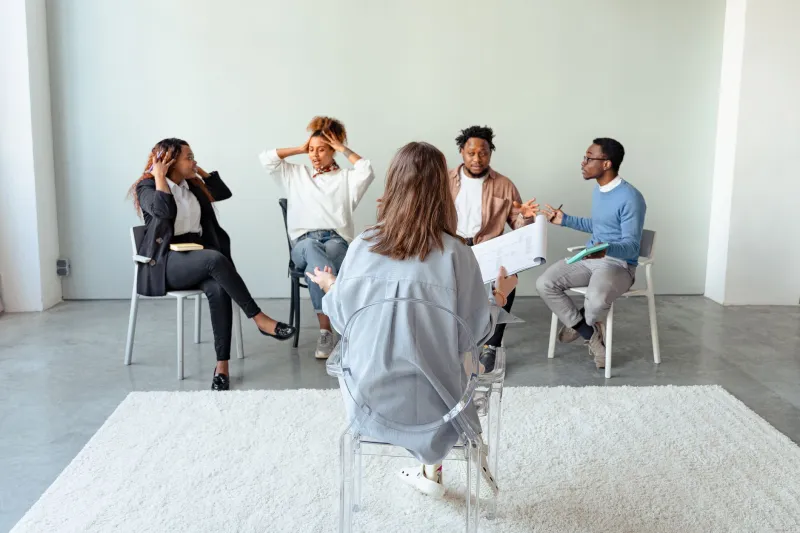
Group-based healing models, which align with collectivist cultural values, have also demonstrated effectiveness. Structured storytelling circles, women's support groups organized through community centers, and peer-support programs that train community members as lay mental health navigators all represent efforts to meet people where they are rather than demanding they adapt to systems designed for different populations.
Dr. Haddad emphasizes that the goal is not to replace clinical care but to build bridges toward it. "Someone might come to a storytelling circle and, six months later, feel ready to speak with a therapist. That is progress. We cannot expect people to leap across a chasm. We have to build the path."
The Cost of Continuing Silence
For Hamid Sarraf, the path remains unbuilt. He continues to describe himself as tired. He continues to handle it.
But his daughter, Dima, who was born in Syria and finished high school in Nashville, has begun therapy. She found her therapist through a friend, paid out of pocket for the first several sessions, and told her father only after she had been going for three months. His response, she says, was a long silence followed by a question she did not expect: "Does it help?"
She told him yes. He nodded and changed the subject.
"But he asked," she says. "That's something."
If we were Syrian, we would understand that survival is not the same as healing — and that the bravest act is sometimes admitting that the weight you have carried across borders and years is heavier than any one person should carry alone.